What the Elder Futhark is
Runes are the letters that Germanic-speaking peoples used before, and for a long time alongside, the Latin alphabet. The Elder Futhark is the oldest form of this runic alphabet. It has 24 runes and was used from roughly the 2nd to the 8th centuries CE, on objects such as jewellery, weapons and standing stones. Later forms — the Younger Futhark in Scandinavia and the Anglo-Saxon futhorc — changed the number and shapes of the runes.
The name “futhark” comes from the sounds of the first six runes: ᚠ ᚢ ᚦ ᚨ ᚱ ᚲ — f, u, th, a, r, k.
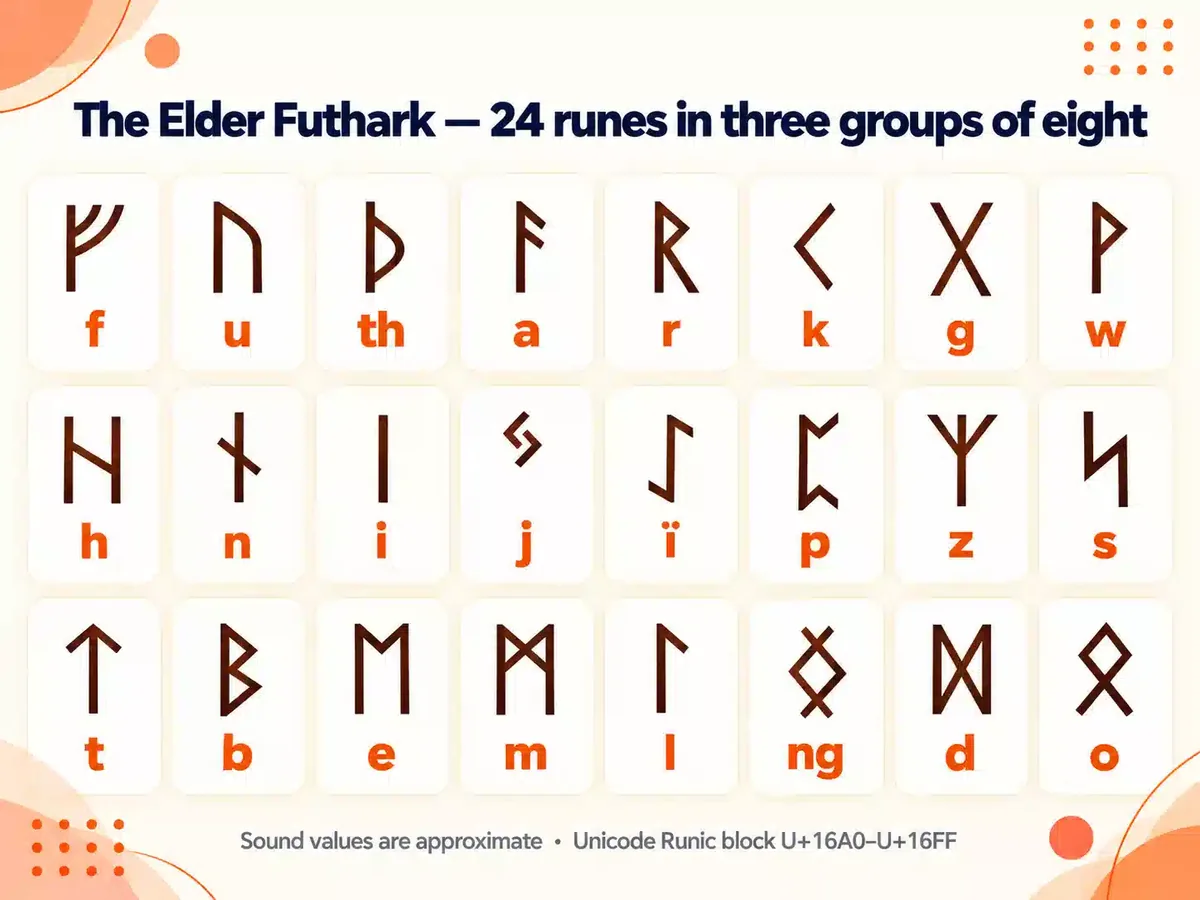
The 24 runes
The runes are traditionally arranged in three groups of eight, each called an ætt in modern usage. The earliest known complete listing of the sequence is on the Kylver Stone from Gotland, dated to around 400 CE.
| Rune | Unicode | Name* | Sound |
|---|---|---|---|
| First group (often called Freyr’s ætt) | |||
| ᚠ | U+16A0 Runic Letter Fehu Feoh Fe F | *fehu | f |
| ᚢ | U+16A2 Runic Letter Uruz Ur U | *ūruz | u |
| ᚦ | U+16A6 Runic Letter Thurisaz Thurs Thorn | *þurisaz | th (þ) |
| ᚨ | U+16A8 Runic Letter Ansuz A | *ansuz | a |
| ᚱ | U+16B1 Runic Letter Raido Rad Reid R | *raidō | r |
| ᚲ | U+16B2 Runic Letter Kauna | *kaunan | k |
| ᚷ | U+16B7 Runic Letter Gebo Gyfu G | *gebō | g |
| ᚹ | U+16B9 Runic Letter Wunjo Wynn W | *wunjō | w |
| Second group (Hagal’s ætt) | |||
| ᚺ | U+16BA Runic Letter Haglaz H | *hagalaz | h |
| ᚾ | U+16BE Runic Letter Naudiz Nyd Naud N | *naudiz | n |
| ᛁ | U+16C1 Runic Letter Isaz Is Iss I | *īsaz | i |
| ᛃ | U+16C3 Runic Letter Jeran J | *jēra | j |
| ᛇ | U+16C7 Runic Letter Iwaz Eoh | *ī(h)waz | uncertain (ï / ei) |
| ᛈ | U+16C8 Runic Letter Pertho Peorth P | *perþō | p |
| ᛉ | U+16C9 Runic Letter Algiz Eolhx | *algiz | z (later r) |
| ᛊ | U+16CA Runic Letter Sowilo S | *sōwilō | s |
| Third group (Tyr’s ætt) | |||
| ᛏ | U+16CF Runic Letter Tiwaz Tir Tyr T | *tīwaz | t |
| ᛒ | U+16D2 Runic Letter Berkanan Beorc Bjarkan B | *berkanan | b |
| ᛖ | U+16D6 Runic Letter Ehwaz Eh E | *ehwaz | e |
| ᛗ | U+16D7 Runic Letter Mannaz Man M | *mannaz | m |
| ᛚ | U+16DA Runic Letter Laukaz Lagu Logr L | *laguz | l |
| ᛜ | U+16DC Runic Letter Ingwaz | *ingwaz | ng |
| ᛞ | U+16DE Runic Letter Dagaz Daeg D | *dagaz | d |
| ᛟ | U+16DF Runic Letter Othalan Ethel O | *ōþalan | o |
* The names are scholarly reconstructions in Proto-Germanic; they are not recorded in Elder Futhark sources, which is why they are marked with an asterisk. Spellings vary between books.
What we know — and what we do not
- Known: the shapes and the order of the runes, from inscriptions; the approximate sound of most runes.
- Reconstructed: the rune names, worked out from later rune poems and related languages.
- Uncertain: the exact sound of a few runes, such as ᛇ, and how runes were first developed — most scholars link them to alphabets of the Mediterranean world, but details are debated.
- Modern additions: many “rune meanings” sold for divination today come from 20th-century interpretations, not from historical sources. NameFonts does not assign meanings to runes.
Runes as Unicode text
All runes are encoded in the Runic block, U+16A0–U+16FF. Because they are in the Basic Multilingual Plane, each rune is 1 UTF-16 unit and 3 UTF-8 bytes — shorter, in UTF-16 terms, than most styled letters. Unicode unifies the Elder Futhark with later runic forms, so one code point can serve several historical variants; Unicode names list several traditional names for the same rune (for example U+16A0 is RUNIC LETTER FEHU FEOH FE F).
Many phones and computers include a font with runes, but not all do — some devices show boxes (see why symbols show as boxes). Test before using runes in a profile or game name.
Writing a modern name in runes
There is no single “correct” way to write a modern name in Elder Futhark, because the alphabet was made for a language with different sounds. Common conventions: write by sound rather than spelling; use ᚲ for both k and hard c; use one rune for th (ᚦ) and ng (ᛜ); and note that there are no separate runes for c, q, v, x or y. The Runes Name Converter follows these conventions and explains each choice.
Respectful use: some runes and rune combinations have been misused by extremist groups in the 20th century and since. If you use runes in a public name, keep to letters that spell your name, and avoid symbols you do not understand.
Frequently Asked Questions
How many runes are in the Elder Futhark?
Twenty-four, traditionally arranged in three groups of eight.
Are rune meanings historical?
The rune names are reconstructions, and most of the divinatory “meanings” sold today come from modern interpretations rather than historical sources.
Can I type runes on my phone?
Yes, runes are Unicode characters (U+16A0–U+16FF), so you can copy and paste them. Whether they display depends on the fonts on the reader’s device.
Sources
- Wikipedia: Elder Futhark — 24 runes, three groups, 2nd–8th centuries, Kylver Stone c. 400, reconstructed names, Unicode range
- Encyclopaedia Britannica: Runic alphabet — runic writing attested from about the 3rd century
- Unicode code chart: Runic (U+16A0–U+16FF) — code points and character names (names verified with Python unicodedata)
Write your own name in Elder Futhark runes and copy it.